
Using AI in Qualitative Interview Research in Academia
If you're a PhD student or academic researcher wondering whether you can use AI for qualitative interview analysis, you're not alone. ChatGPT and other AI tools promise to speed up coding and thematic analysis, but can they maintain the methodological rigour required for peer review? This guide explains exactly when, how, and where AI can help with qualitative research—and where it can't replace human judgement.
Qualitative research is a powerful way to generate new academic knowledge and impactful theory. Yet qualitative research is also time-consuming, often much more so than quantitative methods. Over time, the typical number of interviews in top journal articles has crept up. In recent years, articles in the leading management journals often have 50-100 interviews. Collecting data sets of that size is itself hard work, but conducting a proper analysis takes far longer. Indeed, my own experience suggests that authors often rely on a small subset of highly informative interviews to craft their arguments.
Before large language models, most qualitative analysis software did little to change how quickly we could move from interviews to theory. Many of the new 'AI features' have also been underwhelming, sometimes wrapping a basic chatbot in a complex interface. This gap between what LLMs can do and what qualitative researchers actually need partly motivated us to develop Skimle.
In this blog post, I offer suggestions on the use of AI in qualitative research, along with the key concerns and risks. Given the diversity of qualitative research approaches, this post will resonate most with theory-building, interview-based and non-participatory work in management and organisation studies and related research traditions.
The stages of qualitative analysis
This guide assumes that you have already conducted the interviews and colelcted your secondary data. Despite the growing interest in using AI to conduct interviews (1) and generate synthetic data (2), I am sceptical of their usefulness in the academic context. My hunch is that taking your time to conduct the interview shows respect and help gain more valuable insights. The idea of synthetic data, meaning roughly the use of AI to generate interview answers based on pre-defined personas, feels like an odd way to generate new knowledge.
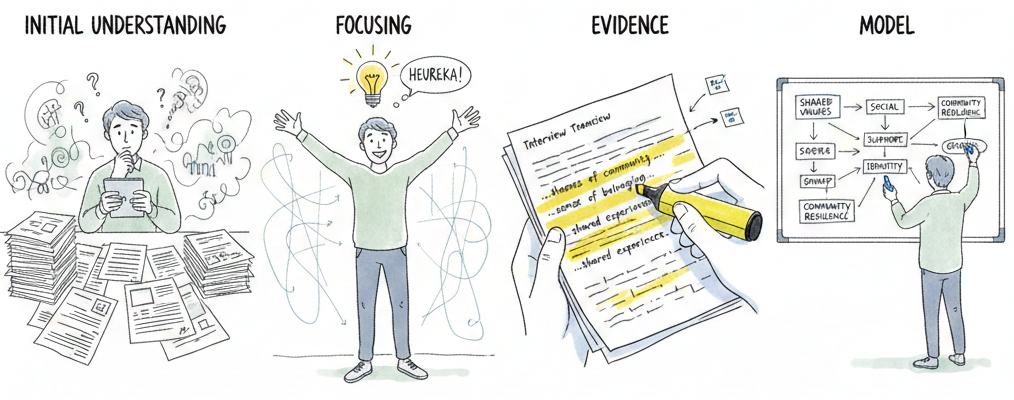
Having collected your data, a typical research process involves four interconnected stages: (1) developing initial understanding, (2) defining (and refining) the theoretical focus and research question, (3) marshalling evidence related to your research question, and (4) developing a theoretical model. Each step can benefit from AI.
1. Initial understanding: Using AI for interview summaries and initial coding
It is often useful to start the analysis by “taking control” of the dataset. To gain an initial understanding, researchers write summary memos or case narratives and often highlight interesting passages from interview transcripts. The purpose is to develop an overview of your dataset, highlighting the most interesting interviews and topics, while gaining an understanding of its weaknesses and limitations.
Chatbots, such as Microsoft Co-pilot and ChatGPT, are great for creating summaries of interviews. Just upload the document and develop a prompt that summarises the interview from the perspective of your research interest. You can complement this document-level analysis with automatic thematic analysis in Skimle, which generates summaries for each of your interview questions across your interviews. If you want to try with your own data, you can try Skimle for free.
However, simply using AI to generate summaries for each interview or interview question does not create understanding. If your goal is to develop theory, you have to also read through your data! Conducting interviews is intensive work, and you probably remember less of what your informants told you than you think.
2. Defining your focus and research questions: “What is this a case of?”
Qualitative research often begins with a clear and focused research question. And then it changes, maybe multiple times. The best qualitative researchers spend a lot of time asking themselves what questions the dataset can help answer. Any dataset can be approached from diverse perspectives, and the choice of perspective has a huge impact on the contribution you can make.
AI tools can help you map out the extent to which your data speaks to different topics. Although you can ask AI what is particularly surprising in an interview, it will probably not be very useful. Rather, you can use AI to probe your own observations and existing knowledge. Skimle is a particularly useful tool for quickly checking the diversity and number of quotes you have related to specific topics. It can help you create broad overviews of your data and the chat interface provides answer to your questions concerning the availability of data related to your theoretical ideas.
3. Organising data related to your research question: AI-Assisted coding and thematic analysis
The answer to your research question is a set of new theoretical claims backed by empirical evidence that convinces the reader. Developing theory is not easy; it involves linking selected parts of your data with existing theory in a coherent yet somewhat surprising way. While there is no formula for crafting a contribution, the process usually involves at least three interconnected moves: coding empirical passages, categorising codes into thematic categories, and linking those categories into an explanatory model of some kind.
AI tools help you go through your data systematically to identify and label empirical passages as well as to suggest thematic categories for those codes. Skimle has been explicitly designed for this purpose: it allows you to define the passages to code and to develop a hierarchical categorisation scheme for them. Our tool helps you take stock of diverse topics that arise in your interviews and export useful reports you can refer to when writing your Findings section.
4. Forming a theoretical model and theoretical contribution (where AI can't replace you!)
The development of an explanatory model is the most creative and intellectual aspect of qualitative research. While AI models can provide you advice, there are no real shortcuts to developing a compelling theoretical explanation. AI tools can occasionally help by suggesting alternative interpretations or by helping you articulate the mechanisms you see in your data, but they cannot replace the deep, iterative thinking that is required for the "creative leap" to a compelling theoretical model. In academic research, the model turns empirical observations into more abstract and generalizable knowledge that adds in an interesting way to the prior literature.
Risks and concerns when using AI in qualitative research
In every stage, the greatest risk of AI is that the researcher fails to attend to the data, seeking to outsource their thinking. It is vital to understand your data thoroughly and craft a contribution that leverages your data to advance more abstract and generic understandings. AI can help with routine tasks such as coding of key passages and it can help you by providing categorizations that you can build on, but it cannot replace your own engagement with the data. There are other important risks that we have been trying to solve with Skimle.
Privacy and GDPR
For European researchers, General Data Protection Regulation (GDPR) provides some strict demands that apply to most non-anonymized interview data. Most importantly, data cannot be stored outside EU and all relevant processes have to be designed in a way that maintains privacy. Some but not all common chatbots provide EU-based processing and data storage. With Skimle, you can be certain that your data never leaves EU and we comply fully with all aspects of GDPR.
Transparency and hallucinations
The rate of hallucinations (made up content and outright false conclusions) has constantly fallen with large language models. Yet, no model is perfect, and it is unclear if the current technology can ever fully remove the possibility of hallucinations. No researcher wants to include a made-up quote in their article manuscript. In Skimle, this risk is managed with our smart software that verifies that all quotes identified by the AI exist in the actual source document. When we cannot find a quote created by AI in the document, our software asks the AI it to re-examine the document until it provides a quote that does exist.
Another key issue is sycophancy: the tendency of AI models to give you what you ask it. For example, if you ask any AI model to provide you with examples of conflict, it will try very hard to find some statements it can interpret as depicting conflicts. In my experience, AI overinterprets quotes far more often than it misses them. Having the verified quotes at hand in Skimle does not resolve this issue, but it makes verifying AI categorizations and chat answers easier and faster.
Example: How AI Can Misinterpret Qualitative Data
Bad approach: Prompt to ChatGPT: "Find examples of organisational conflict in these interviews."
Result: AI over-interprets neutral statements as conflict because it's trying to satisfy your request. You get quotes like "We had different perspectives on the timeline" or "We debated the strategy extensively before reaching consensus." labelled as "conflict."
Good approach: Use Skimle to identify all passages where participants discuss disagreements, decision-making processes, or divergent views. Then manually review to distinguish:
- Healthy debate vs. dysfunctional conflict
- Strategic disagreement vs. interpersonal friction
- Temporary difference vs. persistent division
In our custom chat interface, you can directly refer to categories, for example ask the AI to give examples of disagreements, starting with the most conflictual quotes. The AI organises; you interpret with theoretical nuance.
Iterate!
Qualitative research is not a linear process, but one marked by false starts, reframing, and rethinking your focus, empirics, and contribution. Perhaps the greatest benefit of AI will be the rapid pace at which research can iterate between perspectives, leading to more interesting research results and theoretical contributions.
To sum up, as you iterate through your data, you can lean on AI to support you in key tasks:
- Use AI to speed up summaries and mapping of your dataset.
- Use AI to probe possible research questions and check novelty.
- Use AI to systematically organise quotes and categories.
- Don't outsource reading, theorizing, or ethical judgement to AI.
If you want to try an AI-assisted approach to qualitative research that follows best practices, try Skimle for free. It's built for researchers, academics, and anyone who needs defensible insights from qualitative data.
Related Skimlecast episode
For more tips and discussion on the four steps, check out Skimlecast Episode 5: Four key steps in academic qualitative research
Frequently Asked Questions
Can I use ChatGPT for qualitative data analysis? Yes, but with limitations. ChatGPT can help with interview summaries and initial coding suggestions, but lacks the systematic processing, traceability, and GDPR compliance needed for academic research. Purpose-built tools like Skimle provide better structure for rigorous analysis.
Is using AI in qualitative research accepted by academic journals? Increasingly, yes—with proper disclosure. Leading journals accept AI-assisted analysis when researchers are transparent about their methodology and maintain full audit trails. Document your AI use in your methods section just as you would other analysis tools.
How do I avoid AI hallucinations in qualitative research? Use tools that verify all quotes exist in source documents (like Skimle does automatically). Always manually review AI-generated categories and codes. Never simply use AI outputs in your manuscript. Treat AI as a research assistant, not a replacement for your own analysis.
Does AI-assisted coding compromise research quality? Not if done properly. AI can handle mechanical coding while you focus on theoretical interpretation. The key is maintaining transparency, verifying all outputs, and using AI for organisation rather than thinking. Perspectives on this question are mixed!
What AI tools are GDPR compliant for European researchers? Not all AI tools comply with GDPR. Check that: (1) data is stored in EU, (2) provider has data processing agreement, (3) your data isn't used for model training. Skimle is fully GDPR compliant with EU-based processing.
How many interviews can AI help analyse? AI tools excel at scale. While manual coding becomes a chore beyond 10-20 interviews, AI-assisted tools can systematically process 100+ interviews—the sample sizes increasingly common in top journals.
Before using AI for your qualitative research: Checklist
Before you upload interview transcripts to any AI tool, verify:
[ ] Ethics approval: Does your IRB/ethics committee have policies on AI processing of interview data?
[ ] Data anonymization: Can you remove/pseudonymize participant identifiers easily?
[ ] GDPR compliance (EU researchers): Is data stored in EU? Do you have data processing agreement?
[ ] University IT policy: Does your institution have AI tool restrictions or requirements?
[ ] Journal requirements: Does your target journal have AI disclosure requirements? (Many now do)
[ ] Methodological fit: Is your research approach compatible with AI assistance? (Participatory action research and video ethnography have limited use for text coding)
If you answered "no" or "unsure" to any of these, consult your advisor and ethics committee before proceeding.
About the Author
Henri Schildt is Professor of Strategy at Aalto University School of Business and co-founder of Skimle. He has published a dozen peer-reviewed articles using qualitative methods, including work in Academy of Management Journal, Organization Science, and Strategic Management Journal. His research focuses on organisational strategy, innovation, and qualitative methodology.
Henri developed Skimle after years of frustration with existing qualitative analysis tools that failed to leverage AI's potential while maintaining academic rigour. Google Scholar Profile
References: