The European Commission's Digital Omnibus consultation closed in October 2025 with over 500 detailed responses from organisations ranging from tech giants and industry associations to civil society groups and public authorities. The longest submissions ran for dozens of pages. The total dataset has thousands of pages of policy positions, technical recommendations, and competing visions for Europe's digital future.
Processing this volume of qualitative feedback traditionally takes government analysts months, and indeed as of December 2025 the results are only available as 500 individual files on the EU portal. We analysed the entire consultation response dataset automatically using Skimle — and discovered patterns that might surprise policymakers and interest EU citizens.
The below contains some highlights from our full analysis. You can download a example Excel table from the analysis: EU Digital Omnibus - Skimle table example on criticism or read the full report automatically made by Skimle (pdf copy of Skimle's Word export). Users of Skimle can also request the full explorable Skimle table to explore the data and do their own detailed analyses and exports.
How we analysed 500+ submissions in hours, instead of months, using Skimle
Traditional policy analysis of this scale takes months using pragmatic thematic analysis methods:
- Manual reading: Analysts skim 5,000+ pages
- Note-taking: Capture key points in spreadsheets
- Clustering: Group similar positions manually
- Quote extraction: Copy-paste representative statements
- Synthesis: Write summary documents
Even with a team, this takes multiple months.
Some attempt to use basic AI tools for this initial task, but the results don't hold water. Even if you could fit all the consultation' feedback documents to the context window of the tool, the output lacks transparency and rigor. You could never be sure if specific statements were even considered in the identification of themes, which is unacceptable for public policy making. Small changes to the input or attempts to ask probing questions inevitably alter the outcome.
The Skimle Approach: Systematic AI Analysis
We uploaded all consultation responses to Skimle. The platform:
1. Read each submission systematically. Like a human analyst would, but without fatigue or confirmation bias.
2. Identified key insights. Every substantive policy position, technical recommendation, or criticism was extracted and coded.
3. Organised insights into categories and sub-categories. Skimle automatically clustered over 2000 insights into ~20 main categories such as "Harmonised Digital Rulebook Simplification" and ~200 sub-themes like "Digital-by-Default Tools and Paperless Administration"
4. Linked quotes to themes. Every theme shows exactly which organisations said what, with direct quotes and full traceability back to source documents.
5. Generated synthesis summaries. For each theme, Skimle produced a comprehensive summary capturing the dominant position, key sub-arguments, and notable outliers.
Total time: Upload and initial processing took less than an hour.
Result: A 400-page structured report with:
- Executive summary of major positions
- 20+ thematic categories with full evidence
- Every quote traceable to source organisation
- Patterns of consensus and disagreement clearly visible
This automatically generated summary document is of course not the final output a policy analyst would submit, but it does provide a good starting point for e.g.,
- EU policy analysts to start writing the final summary report
- Interested companies, NGOs and politicians to understand the full feedback by theme
- Using other AI tools to analyse the refined report
Skimle is not limited to producing reports like the attached one, the online platform also allows to explore the data, change the categories, manually edit insights (e.g., code paragraphs as relating to a specific theme) and use AI to do deep dive analyses.
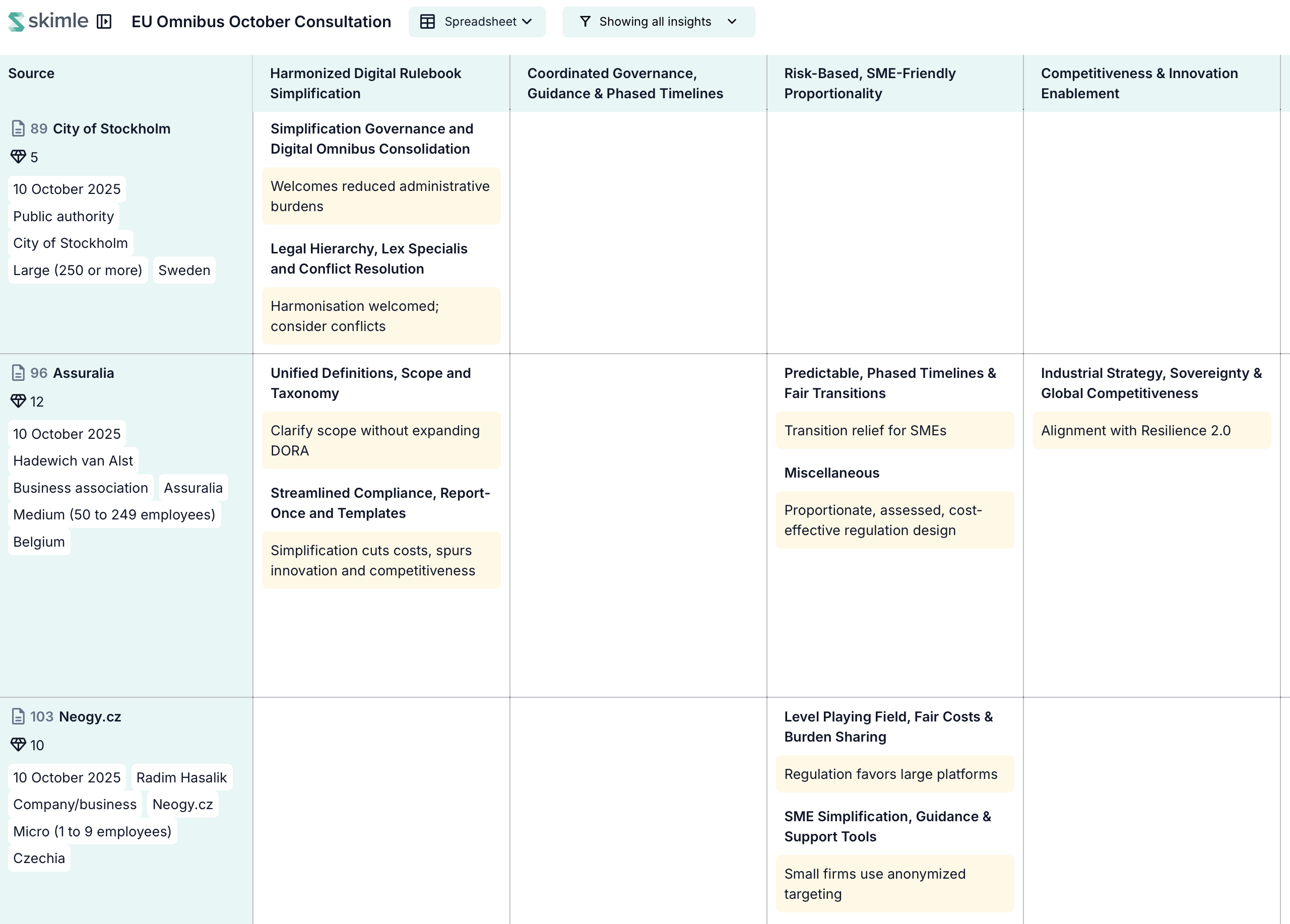
The above table shows a snippet from a popular view in our tool - the Skimle table. This spreadsheet-like interface shows each document as a row, and each category as a column. If a statement raises points relevant to the category, they are shown in the intersection cell. The user can see the exact quotes in the source document and freely edit rows and coding of insights.
We're actually quite proud of Skimle...
We believe proper democratic governance depends on listening to stakeholders. But if the volume of feedback exceeds analytical capacity, consultations become symbolic rather than substantive. This risk is especially true when the environment is rapidly changing (like in the case of digital and AI), and policymaking needs to be fast to stay ahead of emerging changes. Fast iterations depend on fast, high-quality processing.
AI-assisted qualitative analysis in the public sector can play a role in better governance.
- Process more feedback without larger teams
- Identify consensus that might support compromise
- Surface disagreements that require explicit political choices
- Find creative solutions by seeing patterns human analysts might miss
- Maintain full accountability: Every synthesis links to source evidence
This isn't replacing human judgment—it's freeing analysts from mechanical work so they can focus on interpretation, strategy, and recommendation.
Some highlights from the Digital Omnibus feedback summary
The Digital Omnibus aims to simplify Europe's sprawling digital rulebook—GDPR, AI Act, Data Act, NIS2, eIDAS, DSA, DMA, and more—by reducing administrative burden, harmonising requirements, and increasing legal certainty.
After the bottom-up analysis of all 512 statements, on the highest level Skimle concluded that the feedback consensus was pointing towards:
- Strong consensus on EU‑wide maximum harmonisation with clear lex specialis and mutual recognition so firms face one set of rules, one audit/report, and one supervisor—scaling duties by risk rather than size. This means coherent cross‑regime governance across AI, data, cybersecurity, privacy, and sector laws, with standards‑led conformity, single reporting windows, and digital‑by‑default processes (templates, APIs, reusable evidence, identity and trust services).
- Sector primacy should embed horizontal duties into established frameworks (health, finance, transport, energy), retire overlaps, and use transparent carve‑outs.
- Proportionality for SMEs requires tiered obligations, phased timelines, practical support (codes, helpdesks, sandboxes), and calibrated fees and assurance.
- Competitiveness benefits from contestable markets, outcomes‑based funding, fast‑track licensing, innovation‑oriented procurement, and talent mobility.
- Incident reporting should be once‑only, API‑first, and severity‑tiered, with safe harbors and automated routing.
- Assurance and certification should align across acts via EU/international standards, MRAs, outcome‑focused testing, minimal interoperable SBOMs, and lifecycle‑aware credentials.
- Cross‑border data flows need GDPR‑grounded certainty, open standards, common data spaces, realistic cloud portability, and an interoperable identity layer (wallets) to automate authorisations.
- AI oversight should be risk‑tiered, context‑aware, and role‑accurate, preserving research and open‑source flexibility with proportionate transparency.
- Implementation must be sequenced: central guidance, one‑stop supervision, capacity building, comitology clarity, and temporary equivalence.
Looking across the full report, there are dozens of other insights relevant for each part of this complex proposal. To highlight a few ones that we found interesting:
- Despite deep disagreements on how to simplify, virtually every stakeholder agrees the current system is too complex. From Docusign to the Civil Liberties Union for Europe, from Siemens to consumer protection groups—everyone wants clearer rules. The question is what "clear" means.
- Industry stakeholders call for urgency and ambition. For example Technology Industries of Finland's statement captured the frustration of companies it represents in wanting simpler regulation, fast: "A year has passed since the [simplification] report but little progress has been made in simplifying digital rulebooks.". Siemens commented that "This Call for Evidence on the Digital Omnibus completely lacks the ambition European companies urgently need: less bureaucracy, clear and simple rules, and targeted political support."
- Industry stakeholders have very practical asks, e.g., single reporting windows (instead of reporting the same incident to multiple authorities), mutual recognition of certificates across member states, digital-first processes with clear APIs etc.
- Civil rights organizations support streamlining—but draw a hard line against weakening safeguards. The Civil Liberties Union for Europe states: "We worry that the simplification process will instead become a deregulation process... Such an approach risks undoing years of progress achieved through landmark EU legislation such as the GDPR the DSA, and the AI Act."
- On AI regulation, industry is calling for risk-tiered, proportionate obligations focused on demonstratable risks, not blanket categories. For example, Enel advocates: "Narrow definition of high-risk AI to systems directly impacting safety." On foundation models, Anitec-Assinform wants pragmatic thresholds updated as technology evolves: "Raise GPAI systemic risk thresholds to reflect current frontier models"—avoiding the situation where every new capable model automatically triggers the highest compliance tier."
- Civil rights groups want lifecycle-based AI governance with strong accountability. They want precise high-risk scoping, transparency and provenance, robustness and human oversight, post-market monitoring, and upstream GPAI accountability."
- Almost universal support for SME proportionality, with tiered requirements by company size and risk, phased timelines giving smaller players more time, practical support like sandboxes and calibrated fees for assessments and audits.
- The commission floated the idea of centralised consent platforms to simplify GDPR compliance, but some like EMMA-ENPA (European Magazine Media Association) reacts strongly: "We believe that centralised consent would only further reinforce existing gatekeepers, consolidate their data hegemony and further distort competition in the advertising market in their favour - or establish the providers of centralised consent solutions as new gatekeepers."
- The "deregulation threatens democracy" argument raised in an anonymous submission: "Unless Europe creates a regulatory framework that moves away from illiberal influence, there can be no real growth in Europe, as all processes in a globalised economy will ultimately be weakened to comply with the monopolists and autocrats in these illiberal nations." This frames strong regulation as competitive advantage: Europe's rights-respecting framework attracts users and sets global standards.
- Overall, organisations don't primarily complain about how much regulation—they complain about inconsistency. Different definitions, overlapping obligations, conflicting timelines, and 27 national interpretations create more burden than the rules themselves.
Now, every reader and interested stakeholder will of course have their own areas where they want to focus. You should download the full Skimle-generated report and start digging in!
Try it yourself!
Whether you're analysing public consultations, stakeholder feedback, expert interviews or policy documents, Skimle can help you find patterns in large qualitative datasets while maintaining full traceability.
Try Skimle for free - Upload your policy documents, consultation responses, or stakeholder feedback and see how AI-native systematic analysis compares to manual processing.
Contact us for government and institutional licensing - We can work directly with public sector organisations, regulatory agencies, and policy research institutions to handle large-scale consultation analysis requirements. EU-based data processing, GDPR compliant, with single-tenant deployment options available.
About the Authors
Henri Schildt is a Professor of Strategy at Aalto University School of Business and co-founder of Skimle. He has published more than a dozen peer-reviewed articles using qualitative methods, including work in Academy of Management Journal, Organization Science, and Strategic Management Journal. His research focuses on organizational strategy, innovation, and qualitative methodology. Google Scholar profile
Olli Salo is a former Partner at McKinsey & Company where he spent 18 years helping clients understand the markets and themselves, develop winning strategies and improve their operating models. He has done over 1000 client interviews and published over 10 articles on McKinsey.com and beyond. LinkedIn profile