
Public consultation analysis built for democratic governance
Skimle was born in 2025 when the Finnish government wanted a way to reliably assess hundreds of pages of statements to policy proposals. Henri was discovering that extracting insights from qualitative data was prone to hallucinations, and even the most sophisticated RAG systems were more akin to search than actual analysis and synthesis of data, and thus useless for many real world applications. The government needed a tool that would be transparent, reliable, rigorous and safe.
Skimle was developed by automating the rigorous approach academics take in qualitative analysis that our co-founder Henri had used for almost 20 years. Skimle helps EU and government officials analyze public consultations, stakeholder input, and policy documents systematically. AI handles the categorization and ensures every voice is heard. You focus on policy synthesis and democratic accountability.
See in Skimle in action: Full analysis of 500+ consultation feedback statements on EU Digital Omnibus
Systematic analysis that preserves democratic legitimacy
What takes months of manual reading takes days with Skimle—without sacrificing thoroughness or fairness.
- Upload (almost) anything — Skimle can analyze written submissions, hearing transcripts, video testimonies, survey responses, and background documents, all in one project. Handle up to 1,000 documents in a single analysis.
- Automated theme identification — Upload consultation responses, get themes and sub-themes identified in minutes through hierarchical categorization. Every theme links to the exact statements from citizens or stakeholders.
- Taxonomy you control — Merge, split, rename, and reorganize categories to match your policy framework. The AI suggests based on what people said; you structure the analysis.
- Consensus and conflict mapping — Identify where public opinion converges and diverges. See which themes generate agreement and which reveal fundamental disagreements.
- Stakeholder segmentation — Query responses by stakeholder type (NGOs, industry groups, individual citizens, government bodies). Understand whose voices are aligned and whose concerns are unique.
- See the full picture — Intuitive spreadsheet view to navigate all submissions, with AI chat to help you find specific concerns or cross-cutting themes.
- Full audit trail — Every categorization is traceable and exportable. Document how you analyzed input for transparency reports and accountability.
- Works in 100+ languages — Analyze EU-wide consultations or multilingual input without translation delays.
Built for accountable governance
Skimle's approach supports defensible public consultation analysis:
- Systematic processing ensures every submission is considered — no voices are lost in the volume
- Fairness by design: Standardized analysis approach ensures consistent treatment of all submissions, regardless of formatting or submitter resources
- Preserve nuance and dissent: minority viewpoints and outliers remain visible, not averaged away
- Two-way transparency: see which submissions support each theme, and which themes each submission addresses
What traditionally takes weeks or months can be completed in days, without sacrificing thoroughness.
Try for free as an individual, or contact us to discuss institution-level agreements and public sector licensing.
We built Skimle to help in the democratic process
Public consultation processes and other administrative activities face mounting challenges:
- Volume vs. legitimacy: A successful public consultation generates thousands of responses. Reading them all properly takes months. Skipping responses undermines democratic legitimacy.
- Structural bias risk: Without systematic analysis, teams gravitate toward well-formatted PDFs from industry associations while individual citizen responses get skimmed.
- Accusations of selective reading: Manual summaries can be challenged as selective. "You only highlighted what supports your preferred outcome" undermines trust.
- Too condensed reports: Generic themes and frequency distributions fail to capture nuanced concerns or minority viewpoints that matter for inclusive policy.
- Pre-meeting overwhelm: Board papers arrive with 300 pages of background materials 48 hours before the decision meeting.
Skimle addresses these challenges with a systematic approach:
- Systematic processing ensures every submission is considered — no voices are lost
- Standardized methodology: Fair and consistent treatment of all submissions
- Full traceability: Document how you analyzed input for transparency reports
- Rapid first-pass analysis: What takes months can be structured in days — then policy staff focus on synthesis and political analysis
Using AI in public decision-making
We recommend being transparent about AI-assisted analysis in consultation reports. Skimle provides the audit trail to show systematic, comprehensive review. Governance bodies can use Skimle for initial theme identification, then have policy staff validate and add political/contextual analysis — reducing processing time while maintaining democratic accountability.
Unlike generic AI tools that act as search engines with opaque biases, Skimle's structured analysis roots every finding in verified quotes from your documents, eliminating hallucinations and ensuring traceability.
How public servants can use Skimle
Legislative Consultation Analysis
Upload 1,000 responses to a proposed regulation from EU's "Have Your Say" or national consultation platforms. Skimle identifies common concerns, supporter/opponent arguments, and nuanced minority perspectives. Turn months of reading into days of analysis and synthesis.
Example output: We took the EU Digital Services Act consultation with hundreds of text and PDF submissions and used Skimle to turn it into a comprehensive thematic report. Click here to view how the Skimle generated report looks like. Reports like this take minutes to produce, while manually going through each submission takes months of policy analyst time. If you want us to show what Skimle can do with your own consultation feedback responses, let's get in touch!
Stakeholder Mapping & Analysis
Ahead of a major policy decision, analyze input from 50 stakeholder organizations (industry bodies, NGOs, citizen groups, experts). Identify consensus areas, points of conflict, and whose concerns aren't being addressed. See patterns across stakeholder types.
Pre-Meeting Document Review
Municipal board members receive 400 pages of background materials before a budget vote. Upload to Skimle to get structured overview by topic, identify key trade-offs, and surface facts that matter for the decision — all in an evening's prep instead of a weekend. Read more on how to prepare for decision meetings.
Impact Assessment Research
Analyze hundreds of research papers, policy documents, and evaluation reports to inform regulatory impact assessment. Identify evidence patterns, contradictions, and gaps systematically.
Public Hearing Synthesis
Record and analyze testimony from public hearings. Identify recurring themes and specific asks from the public. Ensure written reports accurately reflect what was said, with full traceability to who said what. Skimle can process audie and video files directly, and also keep track of different speakers.
Skimle extracts and organizes the submission contents
Skimle is a unique AI platform grounded on social science methodology and innovative AI workflow that extracts desired content (typically criticism, suggestions, and impact assessments) comprehensively from the provided documents and forms a hierarchical categorization scheme that cuts across your documents. Able to handle up to a thousand documents, the AI service provides a comprehensive map of your public consultations. The service offers valuable features for experts:
- Categorizing themes and topics across diverse response formats
- Identifying consensus and divergence in public opinion
- Extracting actionable insights from lengthy submissions
- Ensuring fair representation of all stakeholder groups
- Maintaining transparency in the analysis process
- Create customized reports for different stakeholders in Word and PowerPoint format.
At the heart of Skimle’s capabilities lies a proprietary process that forms an abstract knowledge structure from your documents. Rooted in verified quotes from the original documents, this structure enables structured comparisons across documents and powers our innovative user interface.
How it works in practice
Here we show a practical example using EU consultation responses to Protection of Minors Guidelines in relation to Digital Services Act from 2025.
Step 1: Upload and define insights
Upload consultation statements to Skimle and define the types of insights you want to extract.
Step 2: Review in spreadsheet view
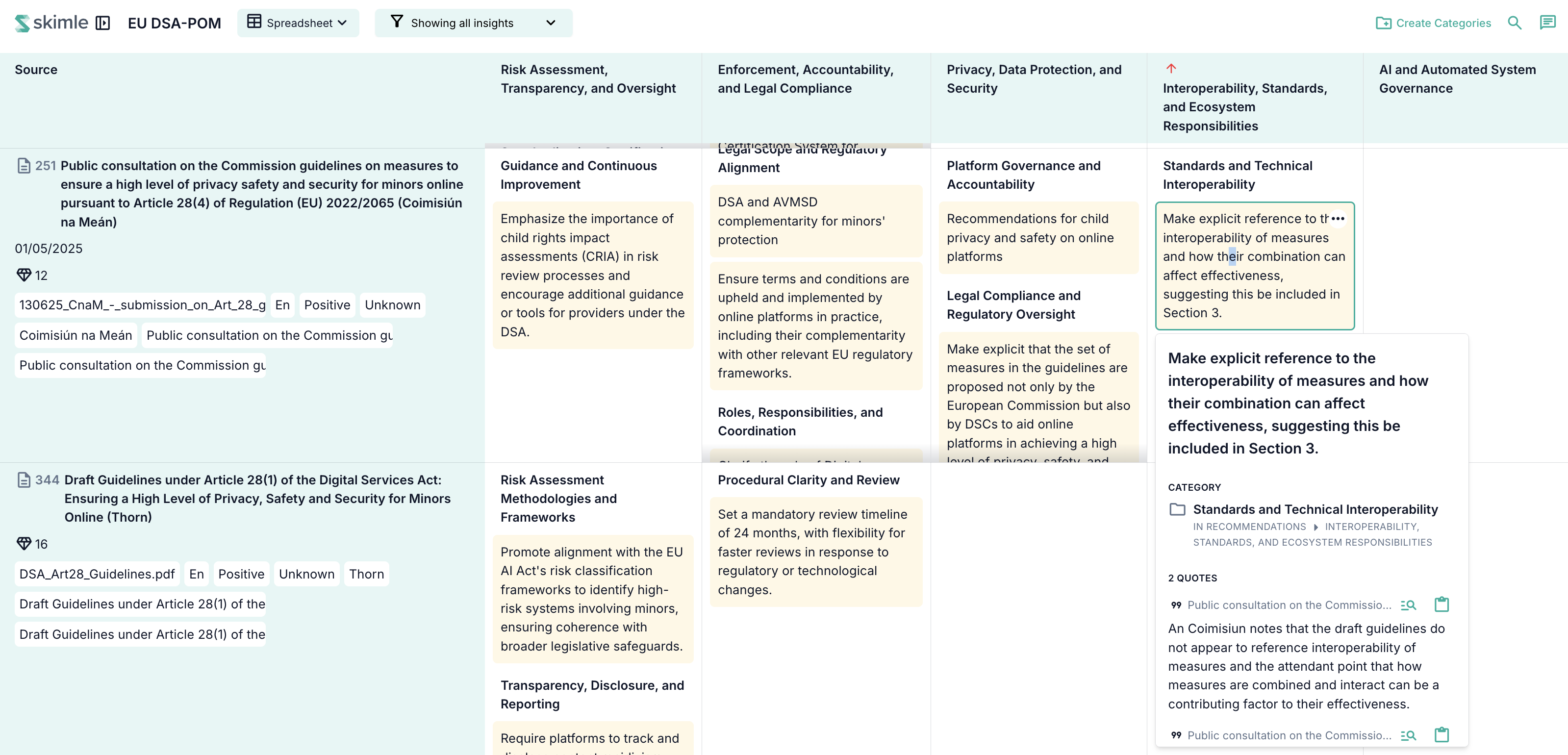
At the core of Skimle is its tabular "spreadsheet" view that organizes content in hierarchical categories, represented by columns. Each submission becomes a row, and identified themes become columns — giving you instant overview of all input.
Step 3: Query with AI chat
Thanks to AI-generated metadata, the advanced chat interface allows you to query topics across all documents or focus on specific subsets, such as governmental organizations, NGOs, or multinational corporations.
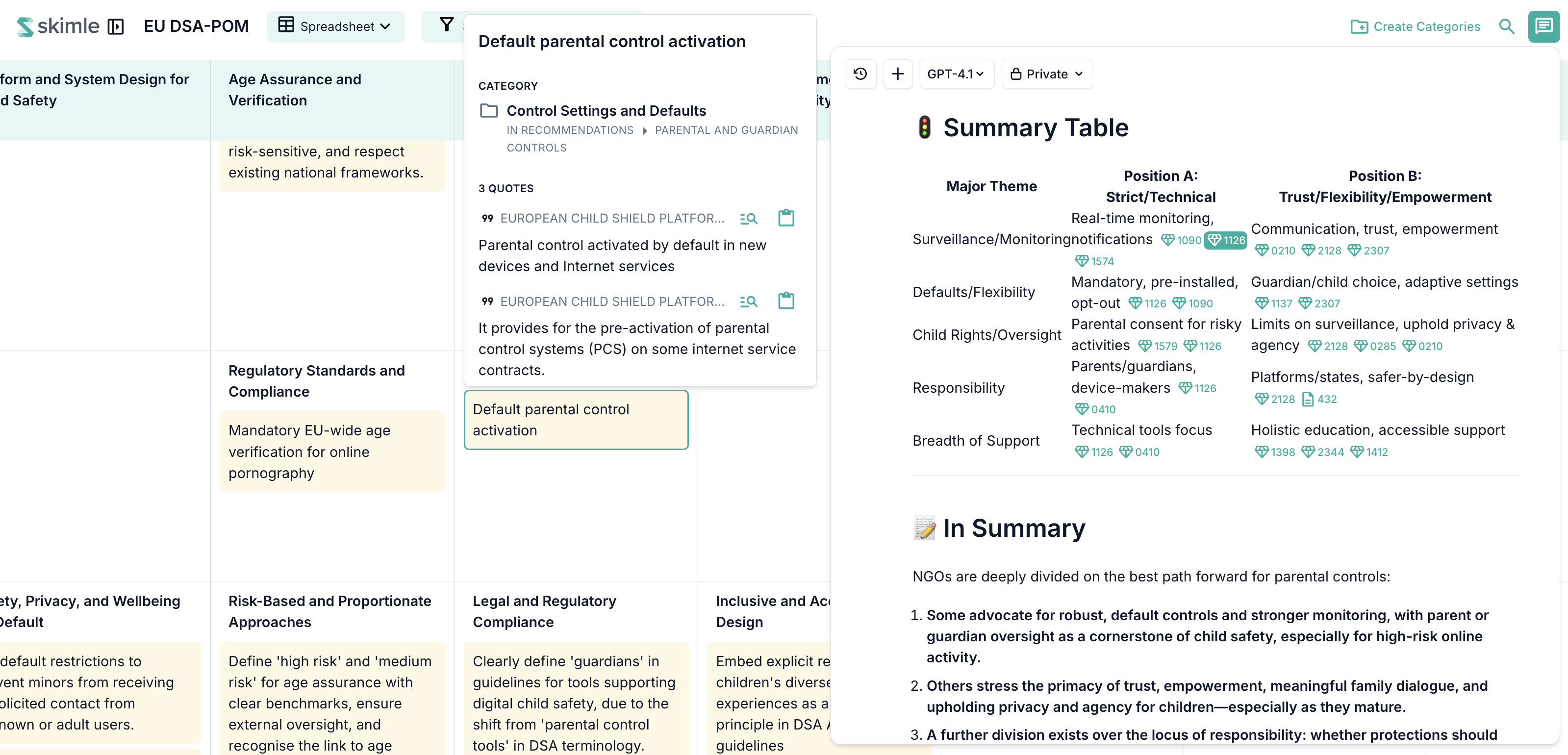
Direct links from chat responses to original quotes allow you to instantly verify AI interpretations and navigate to source materials.
Step 4: Export comprehensive reports
Working with government experts, we've learned that nothing beats a great report. Skimle can export your data into Word and PowerPoint reports showing:
- Overall summaries
- Category-by-category analysis
- Verbatim quotes from different stakeholders
- Stakeholder segmentation
These reports are produced in minutes instead of weeks like traditional manual analysis.
To see what comprehensive reports look like: Click here to view the output report
Comparison: Choosing your consultation analysis approach
When evaluating consultation analysis methods, consider your specific needs. Each approach has its place.
Widely available AI tools, such as OpenAI’s ChatGPT, Google NotebookLM, and Microsoft’s Co-Pilot (in various incarnations, including Studio) provide users with the ability to search for and summarize knowledge from a body of documents. While these are powerful tools for finding information, they have several crucial limitations for knowledge workers who need to take stock of the contents from documents. We've written more on the technical side of the limitations in our blog post on Why RAGs to riches doesn't work
- These tools are essentially search engines; they retrieve a number of paragraphs from provided documents to answer user questsions. The data is not analyzed comprehensively.
- The search process introduces opaque biases. Some documents are ignored while others are used to answer the expert query.
- Contents from different documents are not systematically connected to each other.
- The user has to already know what to ask to get detailed answers. The services provide comprehensive answers only to very targeted queries.
- Many of the generic tools do not back up their conclusions with direct quotes or proide easy transparent access to the original documents.
Public servants commonly have legal responsibilities for comprehensive and unbiased analysis of public consultation documents. The generic AI tools do not perovide the transparency and confidence required for the public consultation process.
Typical choices available for public sector administration
| Manual Analysis | Simplistic Tools | External Consultants | Skimle | |
|---|---|---|---|---|
| Time required | Months | Hours | Weeks | Days |
| Shows all voices | If thorough | No (frequency) | Depends | Yes |
| Full traceability | Manual notes | No | Limited | Yes |
| Preserves nuance | Yes | No | Depends on brief | Yes |
| Stakeholder segmentation | Manual | No | Yes | Yes |
| Fairness & consistency | Depends on analyst | Poor | Depends | Standardized |
| Transparency for reports | Good if documented | Poor | Limited | Excellent |
| Cost | Staff time | Low | €20k-100k+ | Free tier available |
When to choose manual reading: Very small consultations (under 20 responses) where personal reading adds meaningful context.
When to choose Skimle: Any consultation with 40+ responses, tight deadlines, or where democratic legitimacy requires demonstrable thoroughness.
When to choose external consultants: When you lack internal capacity and can afford extended timelines and budgets.
When to choose word clouds and simplistic tools: When you want to look like you analyzed input without actually doing it :)
Scale and capacity
Skimle can handle up to 1,000 documents in a single project. For typical public sector use:
- Municipal consultations (50-300 responses): Optimal
- National policy consultations (300-1,000 responses): Excellent
- EU-wide consultations (up to 1,000 submissions): Supported
- Multi-language consultations (100+ languages): Fully supported
Need more capacity or custom deployments? Contact us for institutional arrangements.
Frequently Asked Questions
Does AI analysis undermine democratic legitimacy?
Not when properly disclosed. The key is transparency about your process. Skimle doesn't replace judgment — it helps organize input systematically so decision-makers can see all perspectives. Many government bodies now disclose using "AI-assisted analysis with human validation" in consultation reports.
Can this handle consultation responses in multiple languages?
Yes. Skimle can analyze submissions in 100+ languages, keeping quotes in the original language while creating cross-language theme identification. Particularly useful for EU-wide consultations or multilingual jurisdictions like Belgium, Switzerland, or Canada.
How do you prevent bias in AI categorization?
Skimle processes every submission systematically using the same approach, reducing the human bias of "I'll focus on the ones that caught my attention" or "I'll prioritize the well-formatted submissions." You maintain full control to validate, adjust, and reorganize themes. The audit trail shows how themes were derived.
Is citizen data handled securely?
Yes. Submissions are processed securely and not used to train AI models. We support GDPR compliance and can provide data processing agreements for procurement. Our data and AI models are stored in the European Union. We offer single-tenant cloud deployment options and can support fully open-source LLMs for maximum security. Public sector data security documentation available.
Can this be procured within government budget constraints?
Skimle is designed to be accessible, with free tiers for smaller projects and transparent pricing for larger initiatives. Many government bodies find the cost lower than hiring external consultants for consultation analysis, while maintaining more control over the process. Contact us to discuss pricing and institutional agreements.
How many documents can Skimle handle?
Skimle can analyze up to 1,000 documents in a single project, making it suitable for even the largest public consultations and policy research exercises.
Ready to handle public input with the thoroughness democracy demands?
Upload consultation responses and see how Skimle identifies themes across submissions — with the transparency and audit trail public accountability requires.
Skimle can be used both by individuals with a subscription, and through institution-level agreements for government bodies and international organizations.
Try Skimle for free to start analyzing consultation responses immediately. Individual policy staff can begin using Skimle right away.
Contact us for institutional licensing to discuss public sector agreements, multi-user deployments, security requirements, and data processing agreements.