
How Skimle helps academic researchers
Skimle is developed by academics for academics. Our co-founder Professor Henri Schildt has decades of experience in qualitative research and articles published in leading management journals. He got tired of the previous generation tools like NVivo, ATLAS.ti and MAXQDA and their bolted-on AI features that were slow and clumsy. Worried by the use of ChatGPT to conduct analyses that severely lack in transparency and comprehensiveness, Henri built Skimle as the platform that replicates the same academically rigorous and transparent workflow, but with AI built into the core. Skimle produces thorough and transparent analyses with tools for researchers to structure the data around their emerging theoretical contributions.
Read Henri's blog post on how to use AI for Qualitative analysis and details about a real-life "what-if" test where the same reseach published in Organization Science was replicated using Skimle.
Skimle: structured AI coding with full transparency
Initial coding of interviews can take weeks manually. Skimle does this without sacrificing methodological rigor, often catching quotes that a human would miss.
- Upload (almost) anything - Skimle can analyse videos, audio files, interview transcripts, books and documents, all in one project
- Automated initial coding — Upload transcripts, get suggested codes and themes in minutes. Every code links to the exact quote.
- Codebook you control — Merge, split, rename, and reorganise categories. Change coding of quotes. Skimle provides suggestions, you add your creative spark.
- Helps understand the data - Intuitive spreadsheet view to navigate and annotate the data, with AI chat to help you
- Full audit trail — Every insight can be traced to original quotes.
- Works in 100+ languages and 1000+ documents — Analyse text across different languages in the same project without translation, and use up to 1000+ source files
Advanced Analysis Capabilities
Beyond basic coding, Skimle offers:
- Consensus & dissent: Use our chat interface to identify where participants agree/disagree across your dataset
- Cross-case analysis: Compare themes across different participant groups (by role, demographics, site)
- Find counter-examples: Our powerful chat interface allows you to ask questions about the data and find counter-examples to emerging model.
Read this overview for a complete view on how Skimle's AI-assisted qualitative analysis platform works.
Try for free or subscribe to a paid plan as an individual, or contact us to discuss institution/team level licensing. Note that if you are an academic with a valid institution email address and page, you can get a 50% discount using the code "ACADEMIA".
Skimle can lead to better quality qualitative research, not just faster
Qualitative research faces mounting pressure:
- Time pressure: With growing academic workload, every revise and resubmit feels tight. Coding and recoding interviews manually takes hundreds of hours, while using very little of your unique expertise.
- Tool complexity: NVivo has 200 features. You need 10 of them, but the learning curve is the same.
- AI skepticism: ChatGPT gives you summaries, but you can't trace claims to sources. That won't cut your research standards or peer review.
- Forest lost while coding trees: Huge manual burden reduces the time available for actual analysis, synthesis and insights.
Skimle's approach mirrors established qualitative methods:
- Inspired by grounded analysis (Glaser & Strauss; Strauss & Corbin) and "Gioa's method" (Gioia & Corley)
- Systematic processing ensures every passage is considered — no cherry-picking
- Two-way transparency: see which quotes support each theme, and which themes each quote relates to
- With initial analysis done by AI, you can focus on your theoretical contributions.
Using AI in Academic Research
All journals require transparency in your methods section about AI-assisted coding. In our experience, researchers benefit the most from Skimle in their intial coding at the beginning of the project and mobilizing all relevant evidence once the theoretical contributions and model become clear. In other words, it sets you up for the "creative leap" and adds evidence to support or revise your interpretation of the data.
We've written a full post on How to Use AI in Qualitative Research which explains our latest thinking on where and how AI can be applied.
Leave a message to be notified once our related methods articles are available.
How researchers can use Skimle
PhD Thesis Based on Interviews
Turn interview transcripts to initial categories in a few minutes and explore the dataset. Rapidly move to refinement, analysis, summaries and insights instead of spending all your time highlighting documents ny hand. Keep full transparency, linking each category and sub-category to direct quotes from your informants.
Analysis of Secondary Data
Pick an interesting question, such as "nature in the works of Kafka", and have Skimle identify all instances across the books, articles, reports, or other archival materials. Identify categories and dig into the initial findings. You can focus on reading through the materials without constantly copy/pasting passages. With Skimle, you can move faster to your own creative analysis instead of getting bogged down in the details.
Skimle allows handling large sample sizes and complex, rich datasets with ease and precision
While qualitative research does not rely on statistical significance, more data often means richer insights and greater confidence in findings. In social sciences, the number of interviews conducted for a single study has crept up over the years, from a dozen to several dozen, and then to more than fifty. Now the leading journals in e.g., the field of management commonly feature studies with close to or even over a hundred interviews.
There are many benefits from collecting more interviews:
- Capture diverse perspectives: Different viewpoints and even contradictory opinions emerge depending on organizational position, seniority, and personal background
- Refine your interview protocol: Knowledge created by interviews greatly depends on the questions posed by the interviewer, and asking the right questions often requires first asking some wrong ones
- Discover minority insights: Some vital information and interesting perspectives are held only by a minority of informants; larger samples increase the likelihood of capturing these rare but valuable viewpoints
- Build confidence in findings: Larger samples provide researchers with confidence to make knowledge claims and give practitioners the assurance needed to take decisive actions
Keeping track of the contents of these interviews is cumbersome. In practice even experienced researchers often focus on a handful of "star informants", while assuming most interviews to be only partially relevant.
Skimle excels at the analysis of interviews by providing users with a comprehensive account of interview contents, organized in categories and subcategories. The platform is calibrated towards inclusiveness, picking up all the content from all interviews related to desired insight types. These can include information stated by the informants, such as:
- Evaluations of products or companies
- Problems or risks
- Major events and timeline
- Feelings and perceptions
- Concepts and understanding
- Interpersonal conflict
- Sources of motivation
Skimle can handle up to 1,000 documents in a single project, easily covering all interview-based studies. Need to analyze thousands of documents for your ambitious archival study? Contact us for institutional arrangements.
The service lays out the key insights in a spreadsheet-like interface, with each interview represented by a row, and the thematic categories by columns. With AI-generated metadata, it is possible to ask chat interface to surface contents based on interviewee characteristics, such as gender or organizational role.
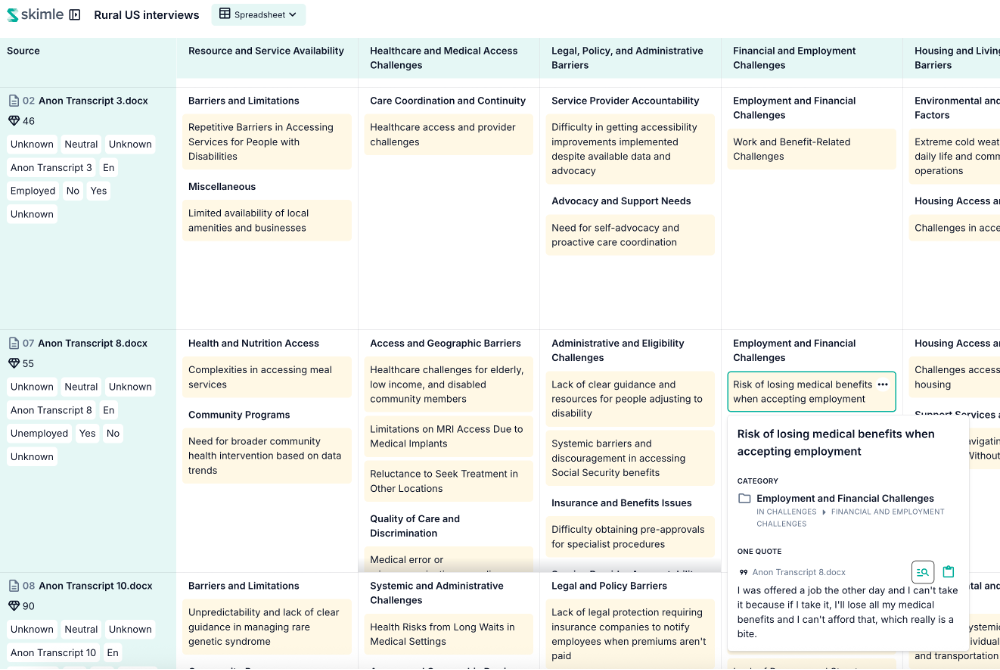
Although not all information is relevant for the user, the initial categorization allows users to zoom into what matters. It is useful to think of Skimle as a kind of a sieve that takes the contents from the interviews and places them in thematic "buckets" of varying relevance to the analyst. Importantly, no insights are lost: everything is placed in a category. The service leverages large language models through a complex iterative workflow that creates a comprehensive analysis of your data, while maintaining transparent linkages to key quotes and their context in the interviews.
Researcher can use the initial categories as a starting point and move or copy desired insights into alternative categories. In near future, Skimle will allow you to highlight, relabel, and move insights around with ease.
Comparison between tools
When starting the analysis of qualitative data, it is good to take stock of the tools available for qualitative data analysis. We've written a full blog post on selecting the right tool for qualitative analysis, but to summarize, consider the table below.
| NVivo/MAXQDA | ChatGPT/RAG tools | Skimle | |
|---|---|---|---|
| Learning curve | Weeks | Minutes | Minutes |
| Methodological rigour | Excellent | Poor | Excellent |
| Full traceability | Yes | No | Yes |
| Speed | Slow (manual) | Fast | Fast |
| Academic acceptance | Established | Questionable | Growing |
| Price | €800-1600/year | Varies | Free tier available |
| Best for | Mixed methods studies, institutional budgets | Quick summaries, initial exploration | Rigorous analysis with powerful AI functionalities |
When to choose traditional tools: If your institution provides licenses, you have months for analysis, and you need mixed methods (qual + quant integration).
When to choose Skimle: If you need rigorous analysis faster, want AI to handle mechanical coding, and need transparent audit trails.
When to choose ChatGPT: If you're not taking research seriously :)
Frequently Asked Questions
Can I cite Skimle in my research?
Yes. We recommend describing "AI-assisted qualitative coding software" in your methods section, similar to how you'd mention NVivo. We have a related methods article in peer review, and once published gives a way to cite the underlying approach.
Will peer reviewers accept AI-assisted analysis?
Increasingly, yes — with proper documentation. The key is transparency about your process. Skimle's export features give you the audit trail reviewers expect.
Can I do inter-rater reliability checks?
Yes. Skimle is designed for open coding, where interrater agreement is typically not calculated, but it excels also in closed coding. Export your codes into an Excel file, have a second coder review a sample manually, and calculate agreement.
Does Skimle work for grounded theory?
Skimle supports inductive coding where themes emerge from data. You can start without merely a broad foci ("insight types") and let themes develop iteratively.
Is my data secure?
Your transcripts are processed securely and not used to train AI models. Contact us for institutional data agreements if required by your ethics board. We are ready to accommodate most IT and security requirements e.g., private single tenancy clouds, locally hosted models and so on - connect with us directly to discuss how to make it happen. Indeed, several universities in Finland are looking to use Skimle with their own Graphics Processing Units (GPUs).
Ready to try rigorous AI-assisted analysis?
Try Skimle for free to see how the tools works with your data or sample datasets. As an individual user you can get started right away and analyse your first datasets in minutes. Note that if you are an academic with a valid institution email address and page, you can get a 50% discount using the code ACADEMIA.
Contact us for institutional licencing to discuss more users, working in teams and options for secure hosting and data processing agreements. Skimle offers institutional licensing for research groups, labs and entire universities, methodology courses and multi-year research projects